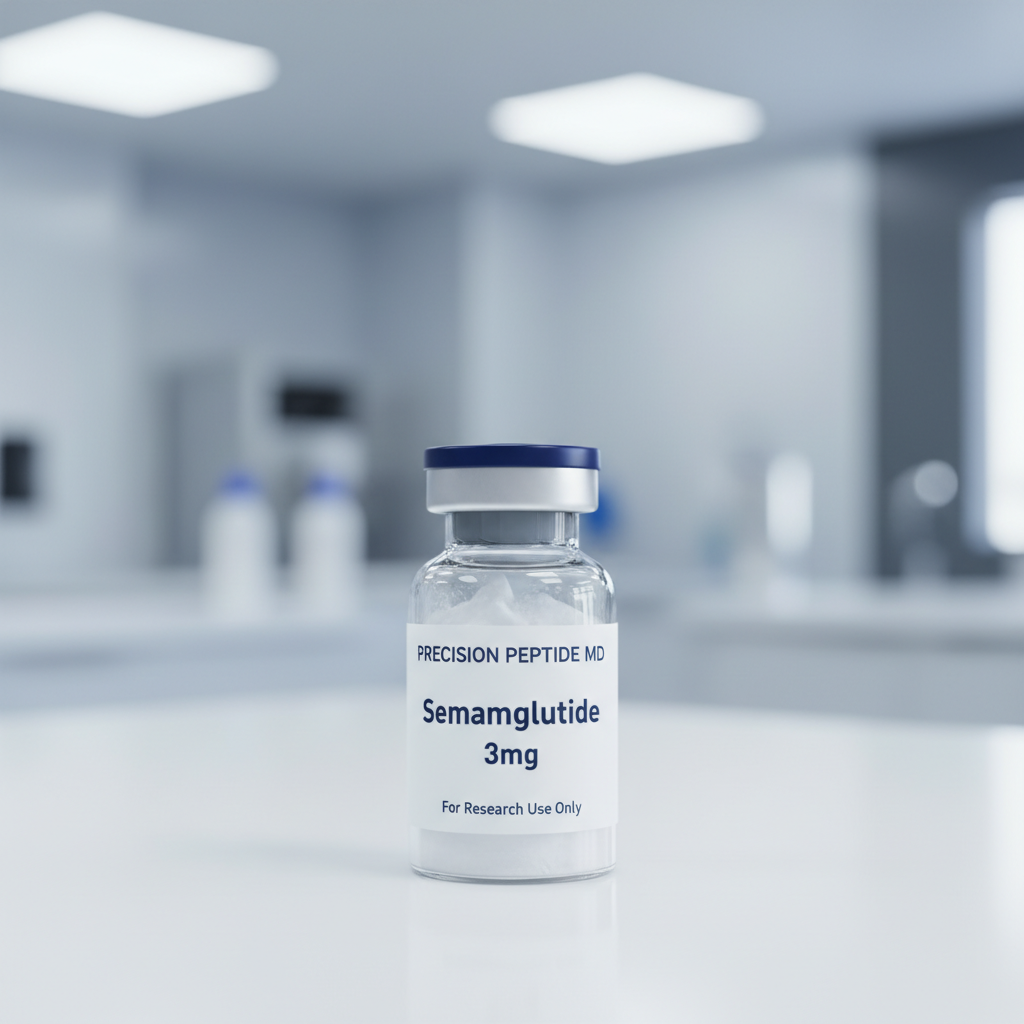
Description
Semaglutide Research Peptide
Semaglutide is a synthetic peptide supplied for controlled laboratory investigation. It functions as a GLP-1 receptor agonist analogue, comprising 31 amino acids with a C-18 fatty acid modification. Researchers study Semaglutide for its involvement in incretin signaling, glucose homeostasis, and its impact on appetite regulation, allowing for repeatable studies under standardized conditions. Its defined structure facilitates consistent experimental outcomes.
Because Semaglutide’s defined structure and specific GLP-1 receptor agonism, researchers value its utility in controlled environments for investigating metabolic pathways. Its consistent interaction behavior with GLP-1 receptors supports data consistency across various experimental setups. Studies focus on understanding its signaling patterns and how these contribute to the regulation of glucose and appetite in controlled research models.
In laboratory settings, Semaglutide is handled following standard peptide preparation and safety procedures. It is supplied as a lyophilized powder. For storage, it should be kept in cool, dry conditions away from light. After reconstitution, ideally with bacteriostatic water, the solution should be refrigerated at 2-8°C. For extended storage, freezing at -20°C is recommended.
The consistent composition of Semaglutide ensures reduced variation in experimental results, making it highly suitable for long-term laboratory projects requiring reliable compound behavior. Its compatibility with structured research workflows provides consistency in data acquisition and interpretation across diverse studies focusing on metabolic regulation.
Ongoing research continues to explore the multifaceted roles of GLP-1 receptor agonists, with Semaglutide serving as a key compound. Its defined sequence and stable behavior make it suitable for controlled research models aimed at elucidating complex physiological mechanisms.
Important Notice: Semaglutide is provided strictly for research use only. This product is not intended for human or animal use, clinical applications, diagnostic procedures, or consumption of any kind. All research must be conducted by qualified professionals in appropriate laboratory environments and in compliance with applicable regulations and guidelines.
Frequently Asked Questions
What is Semaglutide?
Semaglutide is a synthetic peptide classified as a glucagon-like peptide-1 (GLP-1) receptor agonist analogue. It is composed of 31 amino acids and features a C-18 fatty acid modification, which contributes to its extended half-life in research models. Its CAS number is 910463-68-2. This compound is synthesized for controlled laboratory investigation into incretin signaling pathways.
How does the C-18 fatty acid modification impact Semaglutide’s research utility?
The C-18 fatty acid modification on Semaglutide is a key structural feature that enhances its binding to albumin in research models. This interaction contributes to a prolonged circulating half-life, allowing for less frequent administration in long-term in vivo studies. This modification facilitates sustained receptor agonism, providing researchers with a tool to investigate extended physiological responses to GLP-1 receptor activation in controlled settings.
What biological systems are studied using Semaglutide?
Semaglutide is primarily studied in biological systems involved in metabolic regulation. This includes research on the pancreatic endocrine system, particularly in relation to insulin and glucagon secretion, and the gastrointestinal tract concerning incretin effects. Additionally, its influence on central nervous system pathways related to appetite control and energy balance is a significant area of investigation in controlled laboratory environments.
What is the primary mechanism of action of Semaglutide in research models?
In research models, Semaglutide functions as a potent agonist of the glucagon-like peptide-1 (GLP-1) receptor. Upon binding to GLP-1 receptors, it mimics the action of endogenous GLP-1, leading to the activation of intracellular signaling pathways. This agonism is studied for its effects on glucose-dependent insulin secretion, inhibition of glucagon release, delayed gastric emptying, and modulation of satiety signals in controlled laboratory settings.
Why is Semaglutide of interest in metabolic research?
Semaglutide is of significant interest in metabolic research due to its defined and potent GLP-1 receptor agonism. Its ability to influence multiple facets of glucose homeostasis and energy metabolism, including glucose-dependent insulin release and appetite regulation, makes it a valuable tool. Researchers utilize Semaglutide to dissect complex metabolic pathways and investigate the physiological implications of sustained GLP-1 receptor activation in controlled experimental frameworks.
How should Semaglutide be reconstituted and stored for laboratory use?
For laboratory use, Semaglutide, supplied as a lyophilized powder, should be reconstituted with a sterile solvent such as bacteriostatic water. Once reconstituted, solutions should be stored refrigerated at 2-8°C to maintain stability for short-term studies. For extended storage periods, aliquots of the reconstituted peptide should be frozen at -20°C or below to preserve compound integrity and ensure consistent research outcomes.
Reviews
There are no reviews yet.