Description
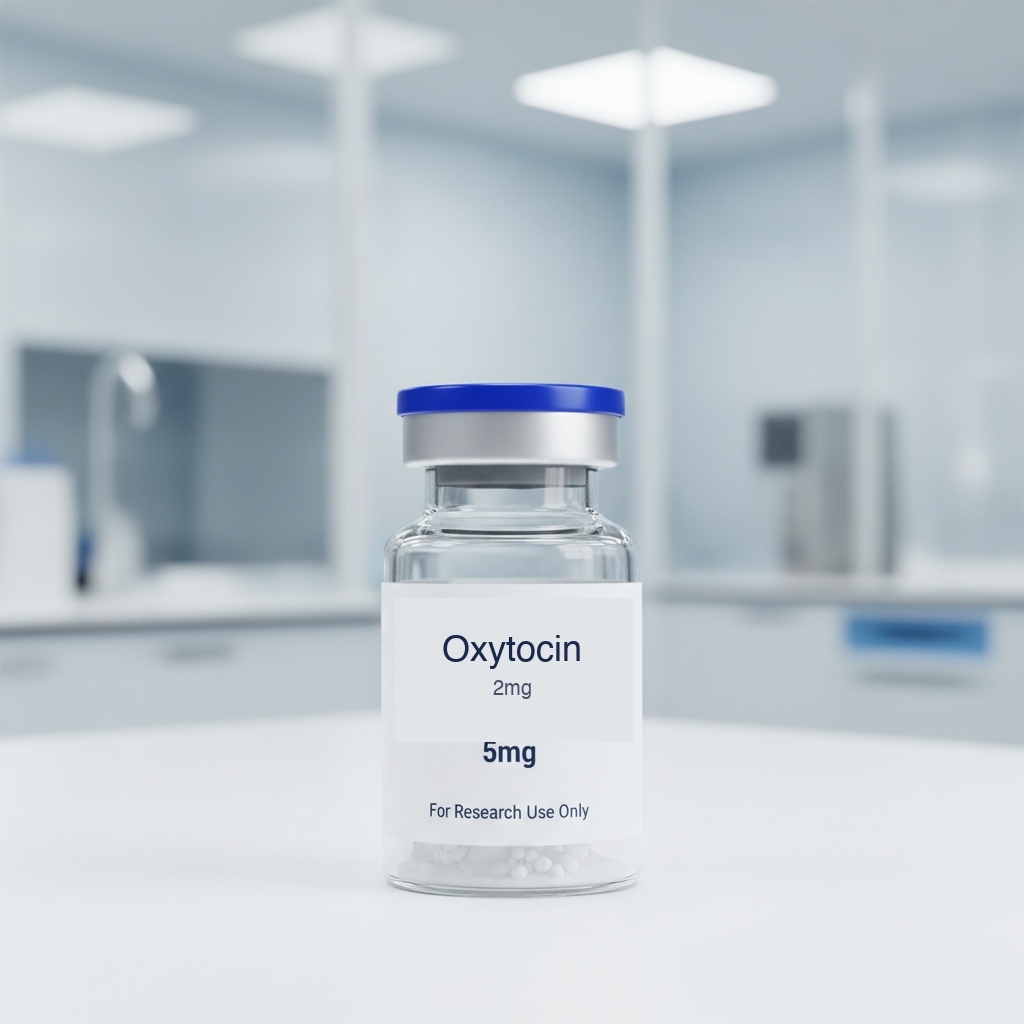
Oxytocin 2mg Research Peptide
Oxytocin is a synthetic nonapeptide neurohormone supplied for controlled laboratory investigation. Composed of nine amino acids with a critical disulfide bond, this compound is studied extensively for its involvement in social bonding, uterine contraction, and anxiolytic pathways. Its precisely defined structure (CAS 50-56-6) ensures consistency, enabling researchers to conduct repeatable studies under standardized conditions for reliable data collection.
Because of its well-characterized interaction with oxytocin receptors, researchers value this compound for its potential to elicit specific and reproducible responses in controlled environments. Studies often focus on its signaling patterns within the central nervous system, examining its role in complex interaction behaviors and its peripheral effects on smooth muscle contraction, ensuring data consistency across various experimental designs.
In laboratory settings, Oxytocin 2mg is handled following standard peptide preparation and safety procedures. It is supplied as a lyophilized powder. For optimal stability, store the product in cool, dry conditions away from direct light. Reconstitute with bacteriostatic water as needed. After reconstitution, refrigerate at 2-8°C for short-term use or freeze at -20°C for extended storage to maintain compound integrity.
The consistent composition of Oxytocin 2mg reduces experimental variation, making it highly compatible with structured research workflows. This reliability is crucial for projects requiring stable and predictable compounds, supporting long-term laboratory investigations where data integrity and comparability across experiments are paramount.
Ongoing research continues to include Oxytocin 2mg due to its defined amino acid sequence and stable biochemical behavior. Its suitability for controlled research models facilitates the exploration of its multifaceted roles in neuroendocrine and physiological systems.
Important Notice: Oxytocin 2mg is provided strictly for research use only. This product is not intended for human or animal use, clinical applications, diagnostic procedures, or consumption of any kind. All research must be conducted by qualified professionals in appropriate laboratory environments and in compliance with applicable regulations and guidelines.
Frequently Asked Questions
What is Oxytocin?
Oxytocin is a nonapeptide neurohormone, meaning it is a peptide composed of nine amino acids that acts as a hormone in neurobiological systems. It is synthesized primarily in the paraventricular and supraoptic nuclei of the hypothalamus and released by the posterior pituitary gland. Its CAS number is 50-56-6.
What is the structural significance of Oxytocin’s disulfide bond?
The disulfide bond in Oxytocin, formed between cysteine residues at positions 1 and 6, is critical for its three-dimensional conformation and biological activity. This bond creates a cyclic structure that is essential for its specific binding to oxytocin receptors, enabling its characteristic physiological and neurobehavioral effects in research models.
What biological systems are studied using Oxytocin?
Oxytocin is studied across various biological systems, including the central nervous system for its roles in social cognition, anxiety, and stress responses. Researchers also investigate its peripheral effects on the reproductive system, particularly its involvement in uterine contraction and milk ejection, as well as its potential influences on cardiovascular and metabolic processes.
How does Oxytocin exert its effects in research models?
In research models, Oxytocin primarily exerts its effects by binding to specific G protein-coupled oxytocin receptors, which are widely distributed throughout the brain and peripheral tissues. This binding initiates intracellular signaling cascades that modulate neuronal activity, smooth muscle contraction, and various neuroendocrine functions, allowing for targeted investigation of its mechanisms.
Why is Oxytocin of interest in hormonal research?
Oxytocin is of significant interest in hormonal research due to its classification as a neurohormone with both central and peripheral actions. Its well-defined role in reproductive physiology, such as parturition and lactation, and its emerging involvement in neurobehavioral regulation, make it a key compound for understanding complex hormone-mediated processes in controlled laboratory settings.
What are the recommended storage and reconstitution guidelines for Oxytocin 2mg?
Oxytocin 2mg is supplied as a lyophilized powder. For long-term stability prior to reconstitution, it should be stored in a cool, dry place, ideally at -20°C. For reconstitution, bacteriostatic water is generally recommended. Once reconstituted, solutions should be refrigerated at 2-8°C for short-term use or aliquoted and frozen at -20°C for extended storage to preserve peptide integrity.
Reviews
There are no reviews yet.