Description
MGF Research Peptide
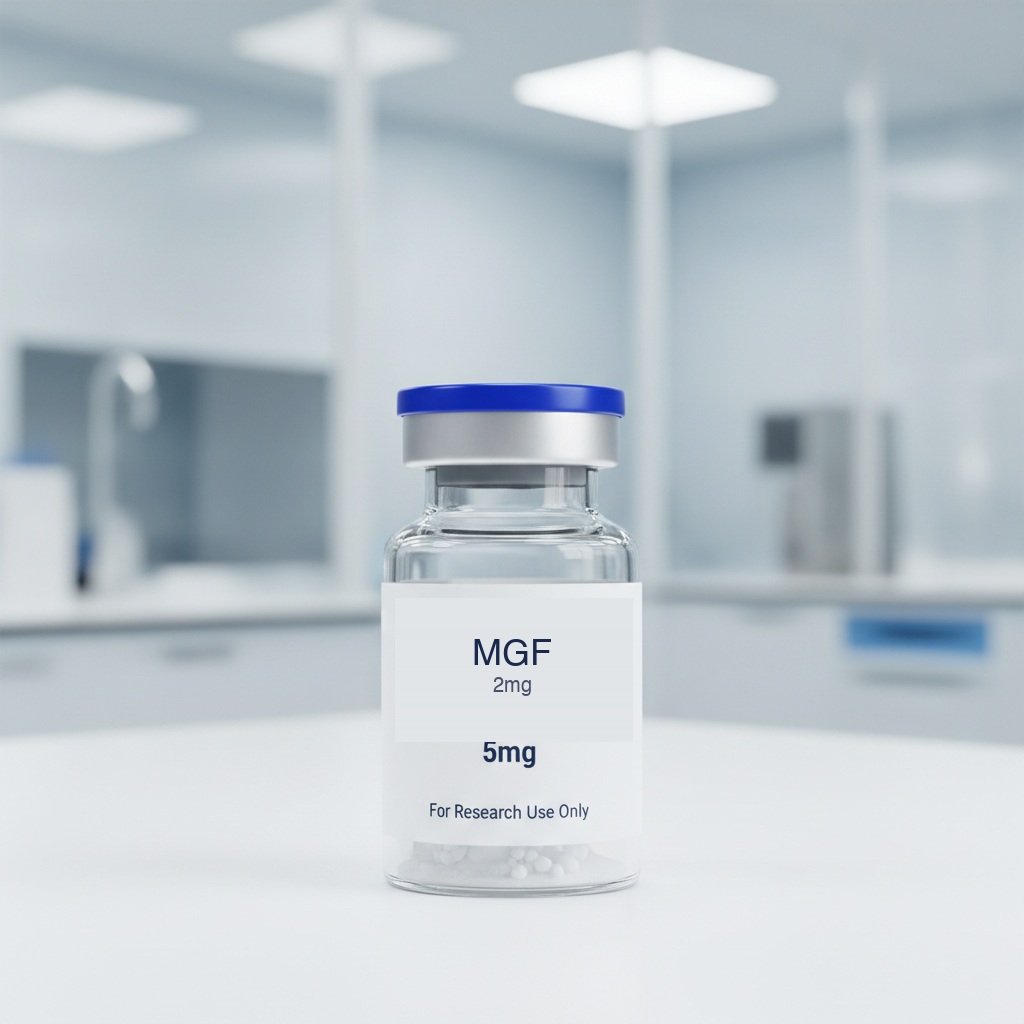
MGF is a synthetic peptide supplied for controlled laboratory investigation. It is a splice variant of Insulin-like Growth Factor-1 (IGF-1), specifically IGF-1Ea, which contains a unique C-terminal extension. Researchers study its localized effects on tissue repair and regeneration, particularly in skeletal muscle. Its defined amino acid sequence allows for consistent experimental conditions and repeatable studies under standardized laboratory protocols.
Because of its specific structure as an IGF-1 variant, MGF is valued for investigating distinct signaling patterns separate from systemic IGF-1. Researchers emphasize controlled environments to isolate MGF’s direct interaction behavior with target cells, particularly satellite cells. This allows for precise data consistency when examining its role in myogenesis and localized cellular repair mechanisms, contributing to a clearer understanding of its compound-specific effects.
In laboratory settings, MGF is handled following standard peptide preparation and safety procedures. It is supplied as a lyophilized powder. Researchers typically reconstitute MGF with bacteriostatic water. For optimal stability, the lyophilized powder should be stored in cool, dry conditions. After reconstitution, it is recommended to refrigerate MGF at 2-8°C, or freeze at -20°C for extended storage durations.
MGF’s consistent composition and defined structure provide high compatibility with structured research workflows. This enables reduced variation in experimental outcomes, enhancing the reliability of data. Its suitability for long-term laboratory projects allows for sustained investigation into its mechanisms and potential applications in tissue regeneration studies.
Ongoing research includes MGF to further elucidate its role in cellular repair and growth pathways. Its defined sequence and stable behavior make it suitable for controlled research models aimed at understanding localized tissue responses and regenerative processes.
Important Notice: MGF 2mg is provided strictly for research use only. This product is not intended for human or animal use, clinical applications, diagnostic procedures, or consumption of any kind. All research must be conducted by qualified professionals in appropriate laboratory environments and in compliance with applicable regulations and guidelines.
Frequently Asked Questions
What is MGF?
MGF, or Mechano Growth Factor, is a synthetic peptide variant derived from the Insulin-like Growth Factor-1 (IGF-1) gene. It specifically refers to the IGF-1Ea splice variant, which includes a unique C-terminal extension (E domain). This peptide is classified as a growth factor analog, studied for its localized effects on cell proliferation and tissue repair mechanisms in various research models.
How does MGF differ structurally from systemic IGF-1?
MGF differs from systemic IGF-1 by possessing a unique 24-amino acid C-terminal extension, often called the E domain. This structural variation is hypothesized to confer localized signaling properties, potentially influencing receptor binding affinity or downstream activation pathways in a manner distinct from full-length IGF-1. Researchers study this structural difference to understand its impact on cellular responses in controlled laboratory experiments.
What biological systems are studied using MGF?
Researchers primarily study MGF in biological systems related to skeletal muscle, cartilage, and bone tissue repair. Investigations often focus on its influence on satellite cell activation, proliferation, and differentiation, key processes in myogenesis. Other areas of study include its potential role in localized tissue remodeling and cellular regenerative responses following mechanical stress or injury in various in vitro and in vivo research models.
What is the proposed mechanism of action for MGF in research models?
The proposed mechanism of action for MGF in research models involves binding to specific receptors, potentially distinct from or in addition to the classical IGF-1 receptor, to activate downstream signaling pathways. This activation is thought to stimulate satellite cell proliferation and differentiation, key steps in muscle repair and growth. Researchers explore its localized effects on protein synthesis and cellular regeneration within targeted tissues.
Why is MGF of interest in regenerative peptide research?
MGF is of interest in regenerative peptide research due to its localized effects on tissue repair and cellular proliferation, particularly in skeletal muscle. Its unique splice variant structure suggests a specific role in initiating the regenerative cascade following tissue damage. Researchers value it for investigating targeted cellular responses, offering insights into localized growth factor signaling independent of systemic hormonal influences in controlled experimental settings.
What are the recommended reconstitution and storage guidelines for MGF?
For MGF supplied as a lyophilized powder, reconstitution is typically performed using bacteriostatic water to ensure sterility. Once reconstituted, solutions should be refrigerated at 2-8°C for short-term use, usually within several weeks. For extended storage, MGF solutions can be aliquoted and frozen at -20°C to maintain peptide integrity. The lyophilized form should be kept in a cool, dry place.
Reviews
There are no reviews yet.