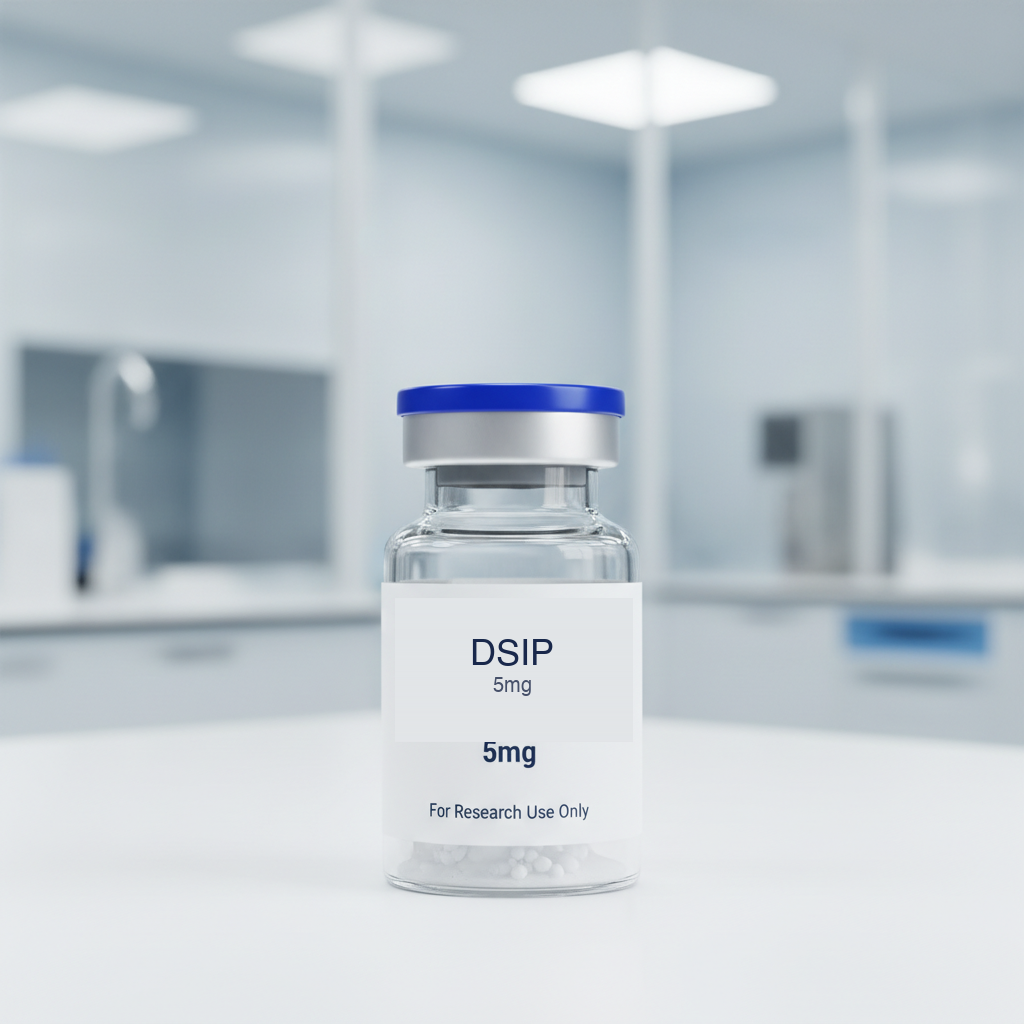
Description
DSIP Research Peptide
DSIP is a research-grade nonapeptide supplied for controlled laboratory investigation. Researchers study DSIP for its potential influence on sleep architecture, circadian rhythm modulation, and physiological responses to stress. Its defined sequence of nine amino acids provides a consistent molecular structure, enabling repeatable experimental conditions and facilitating standardized study designs in neurobiological research.
Because DSIP exhibits a specific nonapeptide structure, it allows for precise investigation into its interaction behavior within biological systems. Researchers value its consistent composition for maintaining data integrity across longitudinal studies, particularly when examining neuromodulatory signaling patterns. This consistency is crucial for understanding its role in sleep regulation and stress adaptation within controlled experimental environments.
In laboratory settings, DSIP is handled and prepared following standard peptide reconstitution and safety procedures. It is typically supplied as a lyophilized powder. For optimal stability, store in cool, dry conditions away from light. Reconstitution with bacteriostatic water is common, followed by refrigeration at 2-8°C. For extended storage, freezing at -20°C is recommended.
The consistent composition of DSIP reduces experimental variation, making it highly compatible with structured research workflows requiring precise control. Its defined chemical properties ensure suitability for long-term laboratory projects focused on neural pathways and sleep-related mechanisms. This consistency supports the generation of reliable and comparable research data.
Ongoing research continues to include DSIP to elucidate its complex roles in neuroregulation. Its defined amino acid sequence and stable behavior make it suitable for controlled research models investigating sleep-wake cycles and stress physiology.
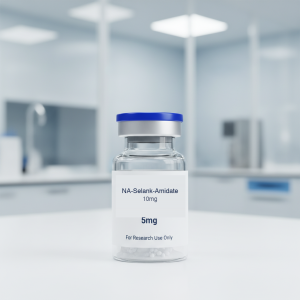
Important Notice: DSIP 5mg is provided strictly for research use only. This product is not intended for human or animal use, clinical applications, diagnostic procedures, or consumption of any kind. All research must be conducted by qualified professionals in appropriate laboratory environments and in compliance with applicable regulations and guidelines.
Frequently Asked Questions
What is DSIP?
Delta sleep-inducing peptide (DSIP) is a naturally occurring nonapeptide, first isolated from the cerebral venous blood of rabbits. It is characterized by its specific sequence of nine amino acids. In research, it is classified as a neuro-modulatory peptide, often studied for its potential involvement in central nervous system functions.
What is the structural significance of DSIP as a nonapeptide?
As a nonapeptide, DSIP consists of a specific chain of nine amino acids, which dictates its three-dimensional structure and potential binding interactions. This defined sequence is critical for researchers investigating its molecular recognition properties and how it might interact with specific receptors or enzymes within various biological matrices in controlled experimental models.
What biological systems are studied using DSIP?
Researchers primarily study DSIP in the context of the central nervous system, particularly focusing on systems involved in sleep regulation, circadian rhythms, and stress responses. Investigations often extend to neuroendocrine systems and their interplay with sleep architecture. Controlled studies examine its effects on brain activity patterns and physiological indicators of stress.
How is DSIP hypothesized to function in research models?
In research models, DSIP is hypothesized to modulate neural activity related to sleep onset and maintenance, potentially through interactions with specific neurotransmitter systems or receptor sites. Studies explore its role in influencing the balance between sleep and wakefulness and its adaptive responses to various stressors. Its precise mechanism of action remains an area of active investigation.
Why is DSIP of interest in neuro-peptide research?
DSIP is of interest in neuro-peptide research due to its observed association with sleep-wake cycles and stress adaptation. Its nonapeptide structure offers a defined compound for investigating specific neuromodulatory pathways. Researchers value its potential as a tool for understanding the intricate peptide-mediated regulation of physiological states within the central nervous system in controlled laboratory environments.
What are the recommended storage conditions for DSIP?
For optimal research integrity, lyophilized DSIP should be stored in a cool, dry place, protected from direct light. Upon reconstitution, it is generally recommended to refrigerate the solution at 2-8°C for short-term use. For extended preservation and to maintain compound stability over longer periods, aliquoting and freezing at -20°C is typically advised in laboratory settings.
Reviews
There are no reviews yet.