Description
Tesamorelin Research Peptide
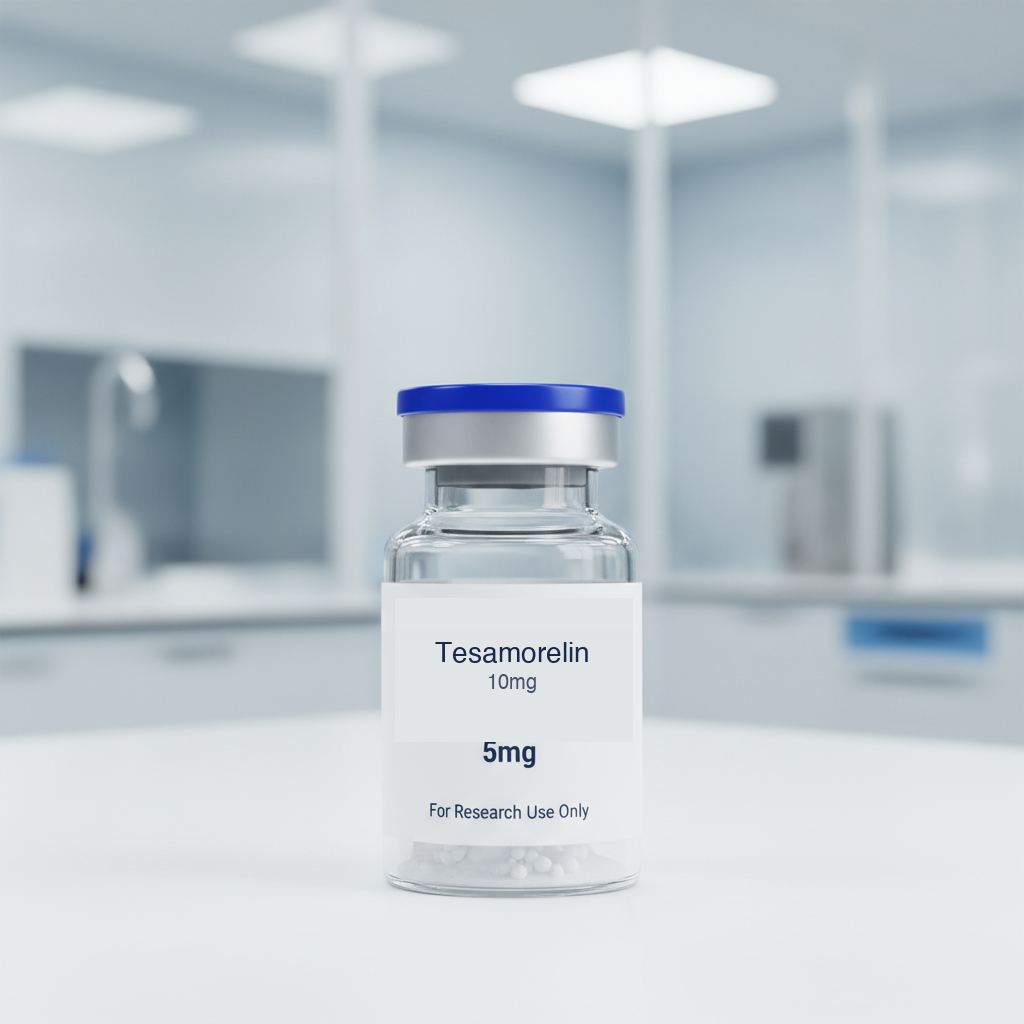
Tesamorelin is a synthetic GHRH analogue supplied for controlled laboratory investigation. This 44-amino acid peptide, modified with trans-3-hexenoic acid, is studied for its specific interaction with the growth hormone-releasing hormone receptor. Its defined structure allows researchers to conduct repeatable studies under standardized conditions, examining its role within the growth hormone axis. Investigations focus on its precise mechanisms of action and downstream effects.
Because Tesamorelin presents a well-characterized structure and specific receptor affinity, researchers value its utility for precise experimental designs. This allows for consistent data collection across various controlled environments, enabling robust analysis of signaling patterns within the somatotropic axis. Studies investigate its interaction behavior with target receptors and its compound-specific mechanisms, contributing to a deeper understanding of metabolic and endocrine regulation in research models.
In laboratory settings, Tesamorelin is handled following standard peptide preparation and safety procedures. It is typically supplied as a lyophilized powder. For reconstitution, bacteriostatic water is generally recommended. After reconstitution, it should be refrigerated at 2-8°C. For extended storage, freezing at -20°C is suitable to maintain compound integrity for long-term laboratory projects.
The consistent composition of Tesamorelin reduces experimental variation, offering high suitability for structured research workflows. Its reliable behavior and defined characteristics ensure compatibility with diverse analytical techniques, facilitating the generation of consistent and reproducible data. This consistency is crucial for long-term laboratory projects requiring stable compound performance.
Ongoing research continues to include Tesamorelin in studies exploring growth hormone axis modulation. Its defined sequence and stable behavior make it a suitable compound for controlled research models, advancing understanding in endocrine science.
Important Notice: Tesamorelin 10mg is provided strictly for research use only. This product is not intended for human or animal use, clinical applications, diagnostic procedures, or consumption of any kind. All research must be conducted by qualified professionals in appropriate laboratory environments and in compliance with applicable regulations and guidelines.
Frequently Asked Questions
What is Tesamorelin?
Tesamorelin is a synthetic 44-amino acid peptide classified as a growth hormone-releasing hormone (GHRH) analogue. It features a unique trans-3-hexenoic acid modification. In research, it is studied for its specific agonistic activity at the GHRH receptor, initiating the release of endogenous growth hormone. Its CAS number is 218949-48-5.
What is the structural significance of the trans-3-hexenoic acid modification in Tesamorelin?
The trans-3-hexenoic acid modification at the N-terminus of Tesamorelin is a key structural feature. This modification is hypothesized to enhance the compound’s stability and resistance to enzymatic degradation in research models. This increased stability is important for maintaining its biological activity, allowing for more consistent and prolonged interaction with the GHRH receptor in experimental settings compared to unmodified GHRH.
What biological systems are studied using Tesamorelin?
Researchers primarily use Tesamorelin to study the somatotropic axis, which involves the hypothalamus, pituitary gland, and liver. Investigations focus on its effects on growth hormone secretion and its subsequent impact on downstream metabolic pathways. Studies also extend to examining adipose tissue regulation, particularly visceral fat, within controlled laboratory environments to understand its systemic influence.
What is the mechanism of action of Tesamorelin in research models?
In research models, Tesamorelin acts as an agonist for the growth hormone-releasing hormone receptor (GHRHR) in the anterior pituitary. This binding stimulates the release and synthesis of growth hormone (GH). The resulting increase in GH levels subsequently influences insulin-like growth factor 1 (IGF-1) production in the liver, modulating various metabolic processes, including lipolysis and protein synthesis, under controlled experimental conditions.
Why is Tesamorelin of interest in metabolic research?
Tesamorelin is of interest in metabolic research due to its capacity to selectively influence the growth hormone axis, which plays a critical role in metabolic regulation. Researchers study its potential to modulate lipid metabolism, particularly in relation to visceral adiposity. By examining its effects on GH and IGF-1, scientists can gain insights into complex metabolic pathways and their interactions within controlled laboratory settings.
How should Tesamorelin be stored for optimal research integrity?
For optimal research integrity, Tesamorelin lyophilized powder should be stored in a cool, dry place, typically at -20°C or colder, away from light. Once reconstituted with bacteriostatic water, the solution should be refrigerated at 2-8°C and used within a specified period, generally a few weeks, to maintain stability. For longer-term storage post-reconstitution, aliquoting and freezing at -20°C or -80°C is often recommended.
Reviews
There are no reviews yet.