Description
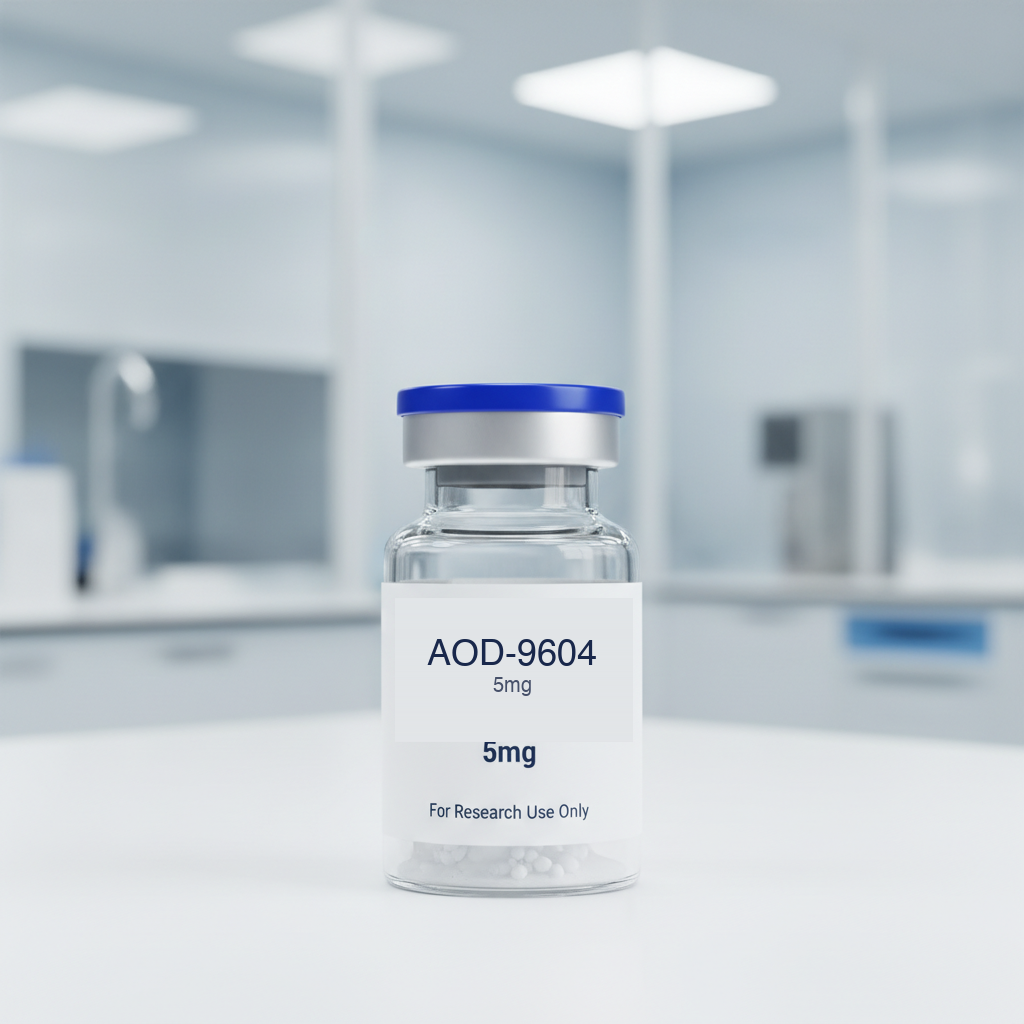
AOD-9604 Research Peptide
AOD-9604 is a synthetic peptide fragment, specifically a modified C-terminal region of human growth hormone (HGH) (amino acids 177-191). It is supplied for controlled laboratory investigation. Researchers study its properties related to lipid metabolism and adiposity regulation. Its defined structure allows for consistent experimental conditions and repeatable studies under standardized protocols, contributing to robust data generation in metabolic research.
Because of its specific molecular target and known mechanism of action, researchers value AOD-9604 for investigating discrete metabolic pathways without the broader anabolic effects associated with full-length growth hormone. This allows for focused studies on lipid catabolism and fat oxidation. Its application in controlled environments contributes to data consistency, enabling precise examination of compound-specific mechanisms and signaling patterns within metabolic research models.
In laboratory settings, AOD-9604 is handled following standard peptide preparation and safety procedures. It is supplied as a lyophilized powder. For optimal stability, store in cool, dry conditions. Reconstitute with bacteriostatic water if applicable. After reconstitution, refrigerate at 2-8°C. For extended storage, freeze at -20°C in aliquots to minimize freeze-thaw cycles.
The consistent composition and defined purity of AOD-9604 ensure compatibility with structured research workflows. This reduces experimental variation and contributes to the reliability of results, making it suitable for long-term laboratory projects investigating metabolic regulation and lipid dynamics.
Ongoing research continues to include AOD-9604 for its defined sequence and stable behavior in controlled research models. Its suitability for investigating specific metabolic pathways contributes to a deeper understanding of lipid-related processes.
Important Notice: AOD-9604 5mg is provided strictly for research use only. This product is not intended for human or animal use, clinical applications, diagnostic procedures, or consumption of any kind. All research must be conducted by qualified professionals in appropriate laboratory environments and in compliance with applicable regulations and guidelines.
Frequently Asked Questions
What is AOD-9604?
AOD-9604 is a synthetic peptide fragment, a modified C-terminal region of human growth hormone (HGH) comprising amino acids 177-191. It is classified as a growth hormone-releasing peptide (GHRP) analog, specifically designed to retain the lipolytic and anti-lipogenic properties of HGH without stimulating IGF-1 production or affecting glucose homeostasis. Its structure is precisely defined for consistent research application.
How does AOD-9604 differ structurally from full-length HGH?
Structurally, AOD-9604 isolates the 177-191 amino acid sequence from the full-length human growth hormone molecule and includes a tyrosine residue at the N-terminus. This modification is designed to enhance its metabolic stability and specificity. Unlike full-length HGH, AOD-9604 lacks the N-terminal and central regions responsible for growth promotion and insulin-like growth factor 1 (IGF-1) stimulation, allowing for targeted study of its lipolytic effects.
What biological systems are studied using AOD-9604?
Researchers primarily use AOD-9604 to study metabolic systems, particularly those involved in lipid metabolism and energy homeostasis. Investigations focus on adipose tissue regulation, lipolysis, and anti-lipogenesis. Studies in controlled models examine its effects on fat oxidation, glucose utilization, and its potential interactions with enzymes involved in lipid synthesis and breakdown within various cellular contexts.
What is the proposed mechanism of action for AOD-9604 in research models?
In research models, AOD-9604 is proposed to exert its effects by selectively targeting beta-3 adrenergic receptors in adipose tissue, leading to increased lipolysis and inhibition of lipogenesis. This mechanism is distinct from the growth-promoting actions of full-length HGH. Studies suggest it may stimulate the release of fat from obese fat cells and reduce the accumulation of new fat, without affecting insulin sensitivity or glucose levels.
Why is AOD-9604 of interest in metabolic research?
AOD-9604 is of interest in metabolic research due to its isolated focus on lipid metabolism without the broader endocrine effects of full-length HGH. Its specificity allows researchers to investigate mechanisms underlying adiposity, fat oxidation, and energy expenditure in a more controlled manner. This compound provides a tool for dissecting the complex pathways involved in weight regulation and metabolic disorders in various in vitro and in vivo models.
What are the recommended reconstitution and storage guidelines for AOD-9604 in research settings?
For research settings, AOD-9604 is typically supplied as a lyophilized powder. It should be reconstituted with a sterile solvent, such as bacteriostatic water, to achieve the desired concentration. Once reconstituted, solutions should be stored refrigerated at 2-8°C for short-term use (typically up to 2-4 weeks). For extended storage, aliquots should be frozen at -20°C to maintain peptide integrity and stability.
Reviews
There are no reviews yet.